Nuclear Power Facilities - Radiation Leak Detection
Quick Facts
Company
Nuclear power facilities
Customer Profile
Organizations responsible for operating and monitoring nuclear power facilities, as well as local communities located near these sites, seeking a reliable, long-range and energy-efficient solution to detect radiation leaks and ensure the safety of employees and residents.
Objectives
- Monitor radiation levels continuously across nuclear facilities and surrounding communities.
- Detect leaks quickly to protect employees and nearby residents.
- Enable long-range, low-power data transmission with reliable network connectivity.
Results
- Real-time radiation alerts delivered to facility managers.
- Extended battery life and low maintenance through LoRa®-based sensors.
- Improved safety and operational visibility using a LoRaWAN® network.
Products & Services
- LoRa®
- LoRa Connect™, LoRa Edge™ and LoRa Core™
- LoRaWAN® network connectivity
Introduction
Nuclear power plants produce about 20 percent* of the nation's power and nearly three million Americans live within 10 miles of an operating nuclear power plant. These nuclear power plants pose a potential danger to those working in and/or living around the area, as radioactive materials can leak causing illness. Because radiation cannot be detected through human senses, communities must implement radiation leak detection sensors throughout the nuclear power plant and the community. The constant measure of radiation can ensure a safe environment for residents and employees.
By implementing a radiation leak detection solution comprised of sensors and gateways embedded with LoRa Technology and a low power wide area network based on the LoRaWAN® protocol, communities with nuclear power plants can measure radiation levels and detect leaks to ensure the safety of its employees and those living in surrounding areas.
Challenge
Nuclear power plants pose a potential danger to employees and nearby residents. Radiation cannot be detected through human senses, requiring continuous and reliable monitoring. Communities must implement radiation leak detection sensors throughout nuclear facilities and surrounding areas to ensure safety.
Solution
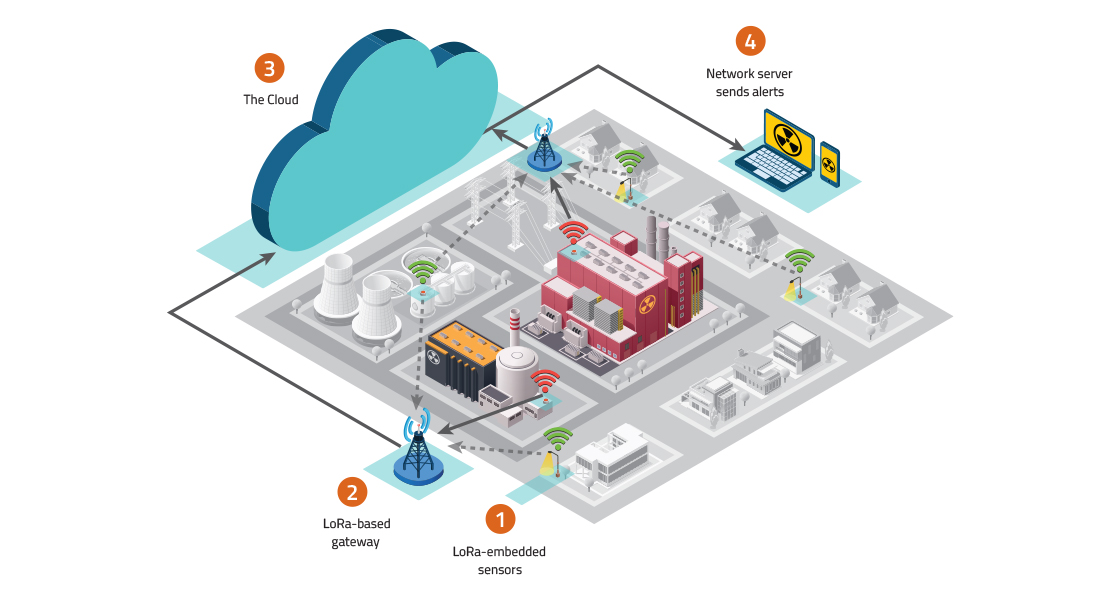
How a LoraWAN-based Radiation Leak Detection System Works
Semtech LoRa Technology enables connectivity, real-time analytics, reporting and additional functions such as geolocation.
- Radiation level data is collected by sensors embedded with LoRa Technology
- Data from sensor is periodically sent to a LoRa gateway
- Gateway sends information to network server where the data is analyzed by an application server
- Application server sends alerts to facility managers via mobile device or computer.
KEY FEATURES OF SEMTECH'S LORA WIRELESS RF TECHNOLOGY
Long Range
Penetrates in dense urban and deep indoor environments, connecting to sensors 15-30 miles away in rural areas.
Low Power
Enables multi-year battery lifetime of up to 20 years or more.
High Capacity
Supports millions of messages per base station.
Geolocation
Enables tracking applications without GPS or additional power consumption.
Standardized
LoRaWAN® specification ensures interoperability among applications, IoT solution providers and telecom operators.
Secure
Embedded end-to-end AES-128 encryption of data ensuring optimal privacy and protection.
Low Cost
Reduces upfront infrastructure investments, as well as operating and end-node costs.


Benefits
Consistently measure radiation levels at nuclear power plant and in surrounding communities to ensure levels remain safe.
Low maintenance costs thanks to LoRa sensors low power operation, ensuring batteries can last 10 years.
Provides reliable RF communication link between sensing infrastructure and LoRaWAN-based network.
Jump-Start Your IoT Development Today:
Learn about Semtech's LoRa® Technology platform www.semtech.com/iot
Become a member of the LoRa Alliance® www.lora-alliance.org